Traveling to the Source of Bali’s Sea Salt

Updated: Mar 25
On the island’s eastern coast, an ancient craft still turns sun, seawater, and patience into one of Indonesia’s most celebrated flavors. Photo and video by Aleksey Shmakov.
By Melissa Alvarado Sierra | Published on March 23, 2026
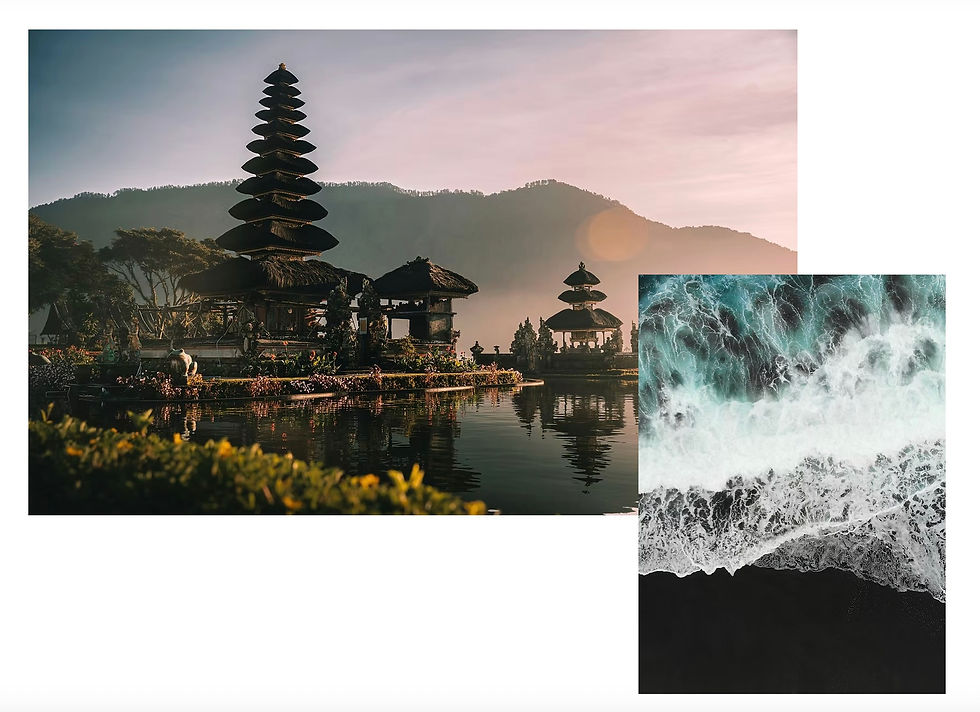
On Bali’s eastern coast, where black volcanic sand gives way to bright, dry light and the ocean seems to arrive with unusual force, salt is not made so much as coaxed out of the landscape. The wind does part of the work. So does the sun. So do the hands of the farmers, who move across the shore as though repeating gestures learned not just from parents and grandparents, but from the coast itself. Standing there in the heat, watching seawater darken the sand before it is lifted, strained, and spread again, I realize that “salt farm” is too industrial a phrase for what is happening. This is something older, more fragile, and far more intimate with place. “We can't force the salt,” Wayan, a local salt maker, tells me. “We wait for the sea, the sun, and the wind to agree.”
Bali is often sold via images of flower baths, jungle villas, plates of tropical fruit, the stylized serenity of a place made legible to visitors long before they arrive. But the eastern coastline tells a different story. It's starker, windier, more elemental. In villages such as Amed and Kusamba, salt production has survived modern pressures because it remains tied to local knowledge, ritual, and a geography that still makes it possible.
The process is deceptively simple. Farmers collect seawater, then pour it over volcanic sand, allowing the ground to absorb the brine. Once the water evaporates, the salt-rich sand is gathered and filtered again with more seawater to create an even stronger brine, which is then left in hollowed coconut trunks or shallow trays to dry in the sun. Over time, crystals begin to form—small, brilliant, and expressive of the coast that produced them. The result is not the blunt, anonymous salt of supermarket canisters. It is mineral, textured, and alive with the conditions that made it. “People think salt is simple because it looks simple,” Wayan tells me. “But our salt carries the taste of this specific coast. You cannot separate it from where it comes from.”
Watching the work up close, I think about how rare it is now to encounter a food product that still depends so visibly on weather, daylight, and human touch. Modern food systems are designed to conceal their own making. Here, nothing is hidden. The shore itself is part of the process. So are the changing seasons, the intensity of the dry months, the patience required when the air carries too much moisture, the vulnerability of an old practice exposed to tourism, rising costs, and the simple fact that younger generations do not always want to inherit such labor.
And yet it's still here.

Part of what makes Bali’s sea salt so compelling is that it belongs to a broader island intelligence about materials and limits. On Bali, land and water are never just backdrop. They are part of a spiritual and agricultural order, shaped by offerings, temple rhythms, and long traditions of stewardship. Even for travelers who only brush against that deeper structure, it is possible to feel that food here emerges from an island view, not just a market. Salt, in that sense, is not merely seasoning. It is island expression.
The best way to understand that is to taste it where it belongs. Sprinkled over grilled fish near the sea. Scattered onto tomato and cucumber at lunch. Folding into sambal. Catching on the skin of something charred and simple. The mild, delicate, and slightly sweet flavor (rather than a harsh saltiness) offers a complex, mineral-rich "umami" taste with a subtle, clean marine aroma. A good salt makes you aware of boundaries, those between land and ocean, blandness and depth. Bali's sea salt does that and more, it's a crunchy masterpiece.

There is, of course, an irony in the fact that travelers increasingly seek out these kinds of experiences precisely because they feel endangered. We want authenticity most when we sense it slipping away. Bali knows this tension well. The island has become one of the most recognizable destinations in the world, and with that recognition has come an endless pressure to transform local life into consumable atmosphere. But on the eastern coast, the work of making salt resists the tourism spectacle. It remains physically demanding, tied to the pace of a day and the demands of a shoreline that cannot be rushed. “The sea gives us this salt, but it also gives us patience. If you hurry it, you get nothing worth keeping. This experience is not for tourists, so we get to keep it.”
That, perhaps, is what moved me most. Not just the beauty of the place, though there was plenty of that—the blue sweep of the water, the dark sand, the clean severity of the coast—but the dignity of a craft that still requires something real of the people who keep it alive. That's when I questioned my presence there. The mere witnessing of this intimate process felt invasive. But Wayan reassures me. "I love sharing this process with those who are jujur penasaran (honestly curious). I know you are because you haven't taken a selfie here."
Travel often encourages a shallow kind of appetite: taste this, see that, move on. But occasionally a place slows you down enough to understand flavor as the visible end of a much larger chain of relationships. On Bali’s eastern coast, it became impossible for me to think of salt as incidental. It was landscape, labor, climate, heritage, and survival.
And once you taste it that way, Bali's salt stops being a minor ingredient. It becomes the whole story.♦


Comments